
As we embark on the Fourth Industrial Revolution, it is clear that technology is playing a central role in all aspects of our lives. The future of higher education highlights the immense need to go beyond and strategically start utilising the ‘Internet of Things’ (IoT) to prepare their graduates for the coming work life and the challenges ahead.
After the completion of my bachelor’s degree, I fell (unintendedly) into the higher education sector. I have experienced the way higher education has changed in the past few years, from the traditional face-to-face full-time study to blended and distance learning models. In 2018, the higher education institution that I work for introduced a new delivery model, blended learning, a whole new way to earn while you learn!
Here is a live video of myself (nervously) attempting to explain what blended learning is for a marketing project at work.
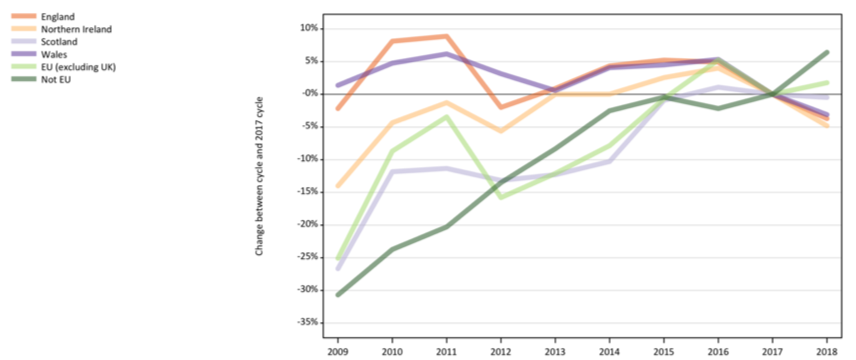
Since 2016 in England, there has been a decrease of UCAS applications (see below UCAS graph) and fewer young adults going into higher education or dropping out before graduation. It was simple – the traditional education models are not working anymore, as students are juggling study with work and other commitments in this fast-paced digital age (Digital Marketing Blog, ND, para 27). It was time for higher education providers to introduce new ways of learning.
Education Has Changed. Permanently.
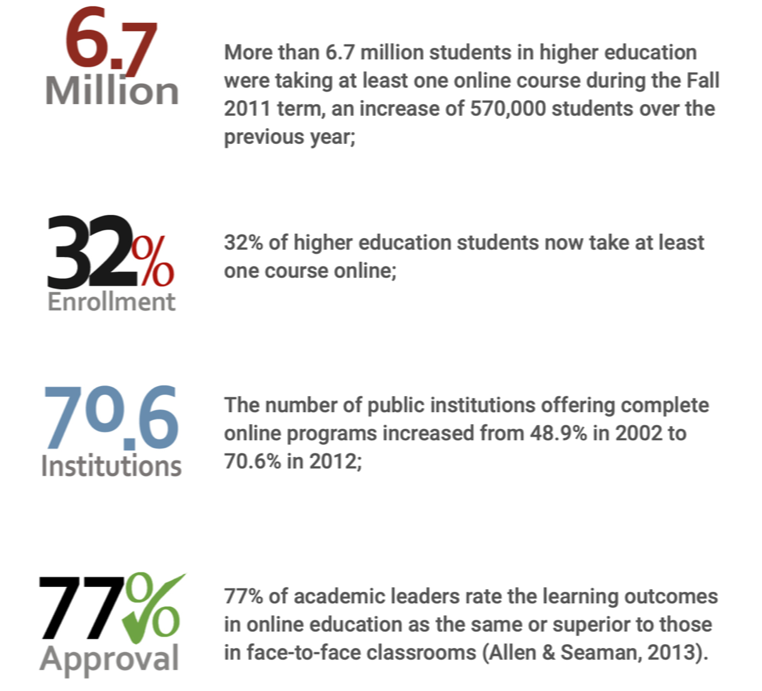
Recent research by Allen and Seaman has shown that more than 6.7 million students in higher education were taking one online course. Moreover, 70.7% of institutions now offer online programs, an increase from 48.9% in 2002 and 77% of academics rate learning outcomes as superior (in Smith, B and Brame, C, ND).
According to the Digital Marketing Institute blog (ND), the changes in education have enabled tutors to track and improve engagement, enhance communication, enable EdTech, personalise teaching and boosting soft skills. I will go in detail about each one below.
‘Big Brother’ Tracking
Have you ever sat in a lecture room thinking ‘what is going on?’ – blended learning to the rescue. In this digital age, blended learning will offer tutors the opportunity to make clear personalised roadmaps for students. Tutors can visualise and track the progress of each student, making the process of identifying signs of a struggling student or education strengths easier and enabling them to act accordingly.
Blurred Communication Lines
We have already seen the shifts in communication patterns. A study from LivePerson (in Digital Marketing Institute blog, ND), found that in the UK about 75% of internet users would rather communicate digitally via email, text message and social media. What happened to meeting your friends for coffee or going to a bar? – the internet happened.
Blurring the physical and the digital world using technology has become part of the Future Internet (Viswanathan, H, 2011, p. 34). But what does this mean for education? Young people want 24/7 communication, access to things and to connect effectively to peers and tutors. From the LivePerson findings, it would go hand-in-hand with the blended learning method and enable students to engage better than the traditional methods.
EdTech – A Digital Field Trip to Space and Beyond!
I remember sitting in physics class and seeing pictures and videos of space, the planets and stars, but what if you could experience this? Hold tight my friends. 3, 2, 1, BLAST OFF. Google Expeditions and Titans of Space are two incredible examples of how Artificial Reality (AR) and Virtual Reality (VR) are changing the classroom experience. Both examples provide virtual field trips and tours to improve science lessons and engagement. The dream.
Student-Centric Personalisation
Have you ever sat in a lecture room with 200-300 students trying to keep up with the lecture? I did – then I gave up and recorded the lecture to watch at my own pace at home. New methods in education will provide an opportunity to change this. For instance, tutors will be able to individualise learning modules based on competency and provide online materials that are accessible to all students.
Tomorrows Job Demand Soft Skills!
The workplace has changed. Employers do not want you to know just the knowledge from your studies, but time management critical thinking and collaboration – natural skills fostered in a blended learning space. A study published by Elsevier (Kashefi, H, Ismail Z and Yusof, Y, 2012) unequivocal response on how the blended learning model impacted soft skills. The conclusions:
- The ability to communicate via email and online spaces improved participation.
- Improved the building of confidence and success as students are actively discussing and vocalising their understanding.
The Digital Campus and Workplace.
Where do I see higher education going? For instance, imagine a ‘Digital Campus’ that monitors when a student, tutor and staff member are on campus or online and then provides them with relevant interactive information on their mobile phones. What will this change? For a prospective student, it could enable them to use AR and VR to give a richer digital experience before accepting their offer and offer tailored interactive information on their performance, progression and uncertainty.
But what does this for staff working in higher education? I used to talk to prospective students on a daily basis, help them with their applications and conduct interviews, however, over the years this has changed. I don’t speak to prospective students anymore, I simply look at their UCAS application and judge them based on the information they provide. This has reshaped our concept of work. As Donkin (2009, p. 1) states ‘our gradual liberation from offices […] is forcing us to reshape our understanding of work. What is work today’. I see future work as working from home, never simply shutting off, having your emails connected to your phone so you ‘don’t miss a thing’ – where did it start and where will it end?
References
Blaine, S and Brame, C. (ND). Blended and Online Learning. Retrieved from https://cft.vanderbilt.edu/guides-sub-pages/blended-and-online-learning/
Digital Marketing Institute. (ND). What Are The Benefits of Blended Learning. [Blog]. Retrieved from https://digitalmarketinginstitute.com/en-gb+/blog/17-05-18-what-are-the-benefits-of-blended-learning
Donkin, R. (2009). The Future of Work. London: Palgrave Macmillan.
Kashefi, H, Ismail, Z and Yusof, Y. M. (2012). The Impact of Blended Learning on Communication Skills and Teamwork of Engineering Students in Multivariable Calculus. Procedia – Social and Behavioural Studies, 341-347.
UCAS. (2018, July 12). June Deadline Analysis: Overview. Retrieved from https://www.ucas.com/file/177106/download?token=7jkRf50b
Viswanathan, H. (2011) Interview in Alexandra Institute, 2011, Inspiring the Internet of Things, FP7 ICT Internet of Things Initiative
 Mark(et) My Words
Great blog Nima, I only finished my undergrad degree seven years ago (seven years, oh god), and already I feel old reading about everything thats changed in that time.
There’s a really interesting paradox in what you’ve explored above which has been clear through learning about digital technologies in all industries. Employers want graduates to hold more soft skills, more interpersonality etc, however at the same time, more processes are being done remotely without human interaction.
You’ve mentioned that face-to-face meetings have been replaced by reviewing a digital profile. Do you think that this lack of interaction changes the way people can be perceived? And do you think that moves like this actually decrease soft skills?
LikeLike
Thank you, Jack! A lot has changed over the years in the higher education sector and I can’t imagine where we will end up in the next few years. There’s no question that technology has opened up more opportunities for people to communicate – we have after all come a long way!
The increased demand for soft skills isn’t unexpected when you factor in the organisational change over the past few years in the business landscape. It does make sense that organisations need a workforce who are leaders, and generally more resilient. However, the shift into the Fourth Industrial Revolution has had an impact on soft skills. For instance, soft skills rely on a ‘human’ factor and dealing with applications based on a digital profile has decreased my sense of empathy and dehumanised applicants. There is a really interesting article on how technology has decreased empathy in students by 40% over the past ten years, you should have a read: https://medium.com/thrive-global/face-to-face-communication-is-more-important-than-ever-cd2f4415b8df.
All of that said, I do believe technology has improved processes and enabled admissions to work through applications quicker, we are able to provide quicker turnarounds and remotely contact other departments (we are all based across the UK).
LikeLike
Fantastic blog Nimat. I have always worked whilst studying. When I was studying my Undergrad, I was working 30 hours a week, 2 hours away from where I went to university. Luckily, all lectures were resubmitted online through Moodle, allowing me to catch up on anything that I potentially missed (for days I couldn’t make it in).
I love the way in which learning platforms are developing, it increases the opportunity for people to develop both themselves and their lives. Take this course for example. This style of learning in my opinion is fantastic. If it wasn’t for this structure, I would of not been able to study a Masters.
Also the thought of bringing AI or VR into a learning dynamic sounds very exciting. Especially when studying Marine Biology or education that requires physical learning.
LikeLike
Thanks Jack! That’s sounds interesting, where did you complete your undergraduate degree?
I agree, I currently work full-time and I too would not be able to complete this masters without technology and the online learning platforms currently provided to us. Who would have thought that we could complete a whole degree online!
LikeLike
I went to the University of Gloucestershire and worked in Oxford and lived in between.
Brilliant world we live in! I hope this course and this qualification provides you with the opportunity you want!
LikeLike
It really is! You too Jack!
LikeLike