
Over the past seven weeks of learning all about the digital business models, watching videos, reading blogs and journals, it is time to reflect on what I have learnt during this time.
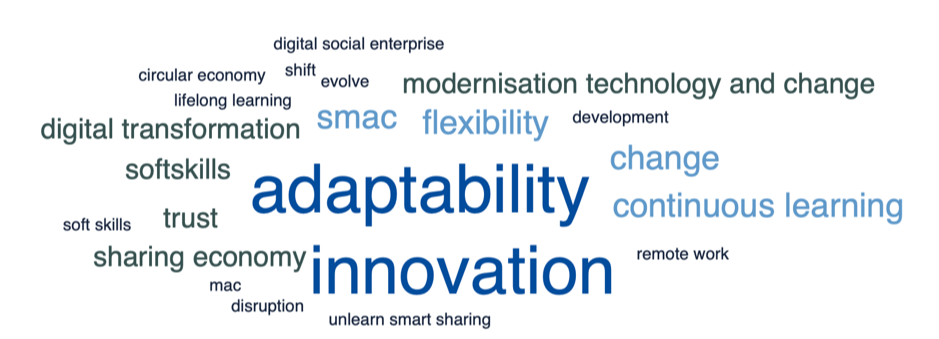
The Changing Nature of Work
It is clear that technology is playing a crucial role in all aspects of our lives. Schwab (2016) states that technologies will dramatically change the nature of work across all industries. During this week of the module I learnt about how various job sectors are changing, especially in higher education and the manufacturing sectors. Gayle’s blog was on how teaching has changed and developed over the years, once we started to talk about the effects of technology on soft skills, it became apparent that “students are less able to communicate verbally, which affects listening skills and emotional intelligence”.
With technology relying less on human interaction, the manufacturing industry required the human interaction, now more than ever. I did not know much about the manufacturing industry but reading Jack’s blog it became apparent that technology is affecting industries and jobs in different ways. It was highlighted in the comments that the manufacturing sector was reliant on human interaction, and not the usual ‘assembly line’ worker, but rather skilled engineers and designers. It was established that there is a moderate shortage of qualified applicants for a white-collar profession, so how we do close this gap in the digital economy?
Retail is Dead, Right?
Before reading the second week blogs, I believed the ‘retail is dead’ trend. However, after reading Reza’s blog on Amazon and how they are expanding into physical spaces and Natasha’s blog on Nike meshing the physical and digital world together, it made me believe in retail again (I guess more shopping).
I found Natasha’s blog on Nike particularly interesting and how Nike have integrated technology into their physical presence. In the comments, a discussion around whether using technology will eliminate the need for human interaction in stores. Natasha stated that Nike are adding value into human interaction with the use of technology. Whether or not this is the case is debatable.
Digital Activities
In the third week blogs, Jack and Victoria explored how digital models have changed the way a business operates. Jack posted an interesting blog on one of my favourite shops, LUSH. It was amazing to explore how LUSH do not market their products but rather depend on building a cult brand following digitally. After reading this blog, it got me thinking about how LUSH have a strong brand with their organic and environmentally-friendly stance, however as various businesses enter the market with similar values, could LUSH be facing a challenge? As Teece, D and Linden, G (2017) state that ‘digitisation, a driver of next-generation competition, adds flexibility but also speeds up the pace of competition’.
Learning New Things
Now that we are at the final week, it has been a seven-week blogging journey of learning new things. Blogging and commenting has broadened my view on the various industries and how technology is changing things. Technology has had a huge impact on organisations, and I learnt that keeping up with the development of technology is vital. In summary, my fellow classmates’ blogs have taught me that technology should be used to enhance the what we do and the way we do things (O’Halloran, 2018, para. 3).
References
Harris, L. (2019). BEMM129Z3 Digital Business Models: What Does The Future Hold. Retrieved 2019, February 24 from https://vle.exeter.ac.uk/mod/page/view.php?id=840381&forceview=1
O’Halloran, G. (2018, June 18). The iPolice – Intelligence Augmented vs. Artificial Intelligence. Retrieved from https://www.linkedin.com/pulse/ipolice-intelligence-augmented-vs-artificial-giles-o-halloran/
Schwab, K. (2016). The Fourth Industrial Revolution. London: Portfolio Penguin.
Teece, D. and Linden, G. (2017) Business Models, Value Capture, and the Digital Enterprise. Journal Of Organization Design 6(1).
 Mark(et) My Words